

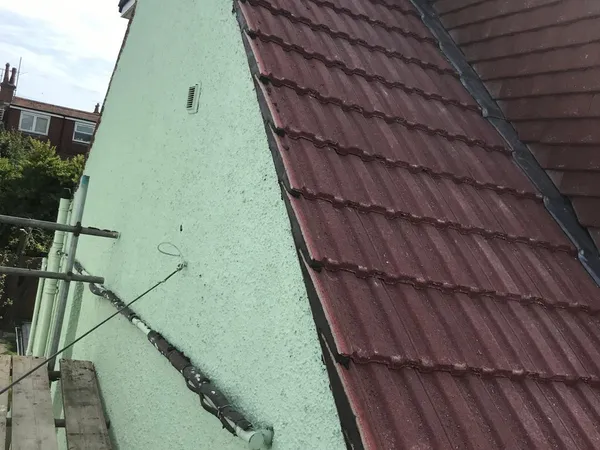

Leadwork in Sussex: Flashings, Valleys & Lead Roofing
Lead flashings, valleys and abutments fitted and repaired on tiled, slate and flat roofs across East and West Sussex.
- Chimney flashings, aprons and back gutters
- Lead valleys renewed
- Failed flashings repaired without re-roofing
- 30+ years' experience
- Free quotes
- £5m public liability insured
- Local Worthing firm
Worthing based, Sussex wide
Leadwork for roofs in Sussex
Royal Roofing Services does leadwork on roofs across Sussex. Based in Worthing, we fit and repair lead flashings, valleys and other details on tiled, slate and flat roofs.
Lead is a small part of a roof by area and a large part of what keeps it dry. More leaks start at a flashing or a valley than in the middle of a slope. Call us on 07957 072703 for a free quote, and a free survey if you own the house.
Related services
Roofs that depend on good lead
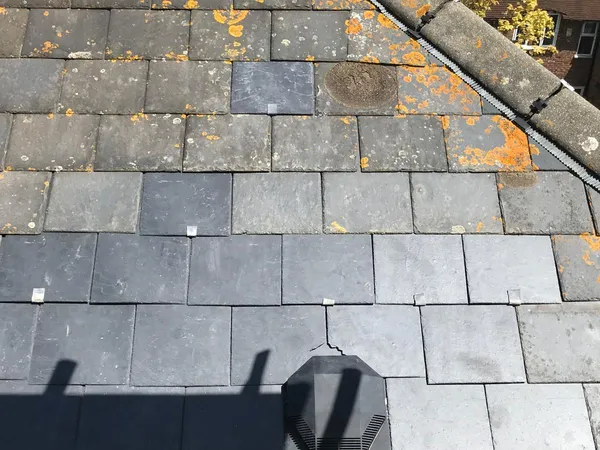
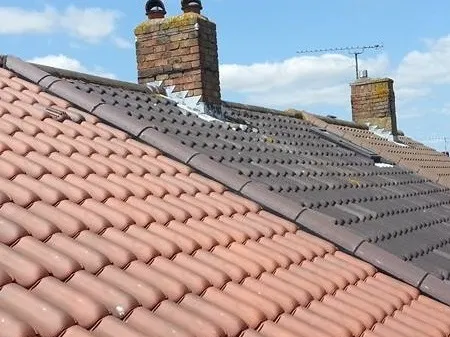
Chimney services
the flashings round a stack fail more than almost any other part of a roof.
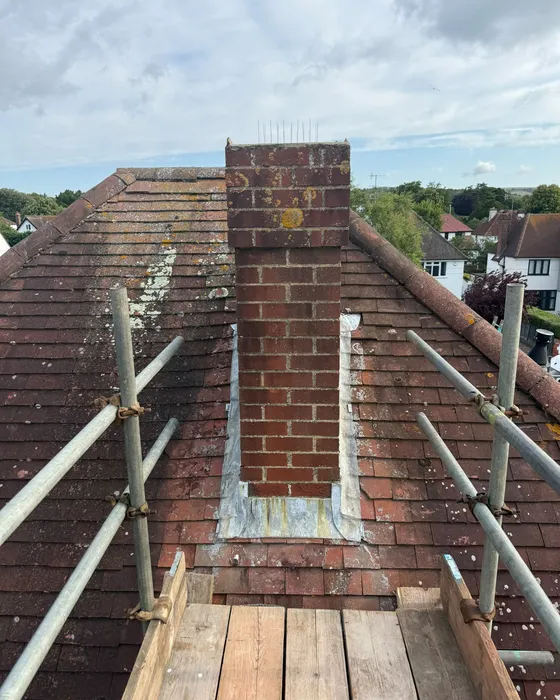
What is roof leadwork?
Lead is used where a roof meets something else: a chimney, a wall, a dormer or a valley between two slopes. Tiles and slates cannot turn a corner or seal against brickwork, so a strip of lead bridges the gap. It is cut and shaped by hand to fit each joint.
Lead suits the job because it is soft enough to be dressed tightly over the shape of a tile and into a mortar joint, and it does not rust. Done well, it lasts for decades. Done badly, it is a common cause of leaks.
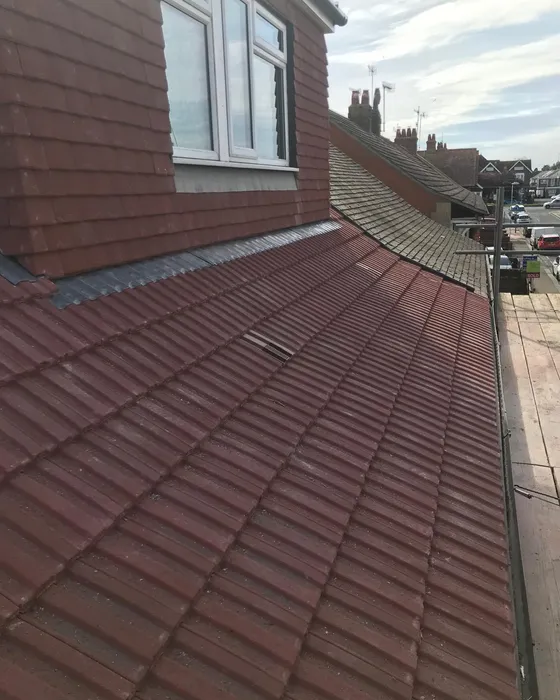
Most houses have lead in more places than their owners realise: around each chimney, along the top of a porch or bay, where an extension roof meets the house wall, at the sides of every dormer and around roof windows.
Free quotes across Sussex
Need a roofer in Sussex?
If the leak is beside a chimney, a wall or a dormer, the lead is the first place we look.
Leadwork we do
Chimney flashings and aprons
The lead around all four sides of a stack, including the back gutter behind it.
Valleys
The lead-lined channel where two roof slopes meet.
Abutments and wall flashings
Where a roof runs into a wall, with step flashing cut to follow the brick courses.
Dormer cheeks and flashings
Lead at the sides and foot of a dormer.
Lead around roof windows and lanterns
Flashing a window or kerb into the roof covering.
Lead repairs on an existing roof
Renewing one failed section without disturbing the rest.
Why lead fails
Lead rarely wears out. It fails because of how it was fitted, or because something around it has moved.
Pieces fitted too long
Lead expands in the sun. Long lengths have nowhere to go and split.
Mortar falling out
The top edge of a flashing sits in a joint. When the pointing goes, the lead comes loose.
Wind lift
Flashing that was never clipped down peels back in a gale.
Thin lead
Lead that is too light for the job creases and cracks.
Blocked valleys
Leaves and moss hold water until it finds its way over the edge.
Earlier repairs
Sealant and flashing tape over a split hide the fault for a while and trap water behind it.
Materials and methods
How lead should be fitted
Lead sheet comes in different thicknesses, known as codes. Thinner lead is used for soakers hidden under tiles and slates. Heavier lead is used for flashings, and heavier still for valleys and other places that carry a lot of water.
Good leadwork follows a few simple rules. Each piece is kept short enough to expand and contract without splitting. Joints are lapped so water runs over them, never into them. The top edge is turned into a joint in the brickwork, wedged and pointed. The free edge is held with clips so the wind cannot lift it.
New lead is often finished with patination oil, which stops the white staining that fresh lead can leave on the tiles below it.
Lead repairs and leaks
Cracked, lifted or split lead lets water in, often around the chimney. We can repair a failed flashing without re-roofing, and will tell you if the lead needs replacing instead.
If you have a leak, move belongings away from the drip and do not go on the roof. Call us on 07957 072703 and we will arrange to come and assess it, usually the next day. See roof repairs.
Step by step
How a lead repair is done
Find the fault
We trace the leak to the flashing, valley or joint that has failed.
Open up
Tiles or slates beside the lead are lifted so the whole detail can be seen.
Strip the old lead
Failed sections come out, along with loose mortar.
Fit new lead
Cut, dressed and lapped in short lengths, fixed and clipped.
Point in
The top edge is wedged into the joint and sealed.
Make good
The tiles or slates go back and the area is checked.
What affects the price
What affects the price of leadwork
We do not publish prices. Leadwork is priced on these.
How much lead
Lead is a costly material, and the length and width add up quickly.
The thickness needed
Valleys and exposed details need heavier lead.
Access
A chimney in the middle of a roof needs scaffolding.
The detail
A straight apron is simple. Step flashing up a wall takes longer.
What is behind it
Rotten timber in a valley or behind a dormer cheek.
Brickwork
Joints that need repointing before lead can be fixed into them.
Done properly
Leadwork done properly
Leadwork is easy to do badly and hard to check from the ground. These questions help.
- Is the old lead being replaced, or patched with sealant or tape?
- Will the new lead be fitted in short pieces with laps, not one long strip?
- How is it fixed at the top, and how is it held down at the bottom?
- Is the thickness of the lead right for where it is going?
- Will the brickwork be repointed where the lead is let into it?
- For a valley, are the boards underneath being checked?
Leadwork with other roof work
When we re-roof, the lead around chimneys, dormers and valleys is part of the job.
Complete roof replacement
, where all the lead is renewed with the roof
Roof windows
, for lead and flashing around the frame
Chimney repointing
, so new lead goes into sound joints
Flat roofing
, where a flat roof meets the house wall
Can you repair lead flashing without re-roofing?
Often, yes. When the lead is cracked or lifted but the rest of the roof is sound, we repair the flashing. We will tell you if a bigger job is needed.
Do you do leadwork on flat roofs?
Yes, where lead meets walls and upstands. Our flat roofs are felt. See flat roofing.
How long does lead last?
Done well, it lasts for decades. Failures usually come from poor fitting or movement in the roof, not from the lead itself.
How much does leadwork cost?
Every job is different, so we give a free quote after we have seen it. See our cost guide.
What is step flashing?
Lead cut in a stepped pattern to follow the courses of brick where a sloping roof meets a wall. Each step is turned into a mortar joint.
What is a soaker?
A small piece of lead tucked under each tile or slate where the roof meets a wall or chimney. The flashing above then covers the soakers.
Can a split in lead be sealed?
Sealant is a short-term fix at most. A split usually means the piece is too long or too thin, and it will split again beside the repair.
Why is there white staining below my new lead?
Fresh lead can shed a white carbonate when it first gets wet. Patination oil applied when the lead is fitted prevents it.
Is the lead renewed when you fit a new roof?
Yes. On a re-roof the flashings, valleys and soakers are renewed where needed as part of the job, because old lead refitted over new tiles is a false economy.
Leadwork around the county
Lead matters most where roofs are old or complicated. Victorian terraces in Brighton & Hove have parapet and valley gutters. Period homes in Chichester and Lewes have chimneys and abutments everywhere. Seafront roofs in Worthing and Eastbourne need lead that is clipped against the wind, and the dormers on chalet bungalows around Horsham and Crawley all depend on it.
Free quotes across Sussex
Get a free quote for leadwork
Call us on 07957 072703 or use the quote form at the top of the page.